API vs MCP: What’s the Difference in the Age of AI Agents?
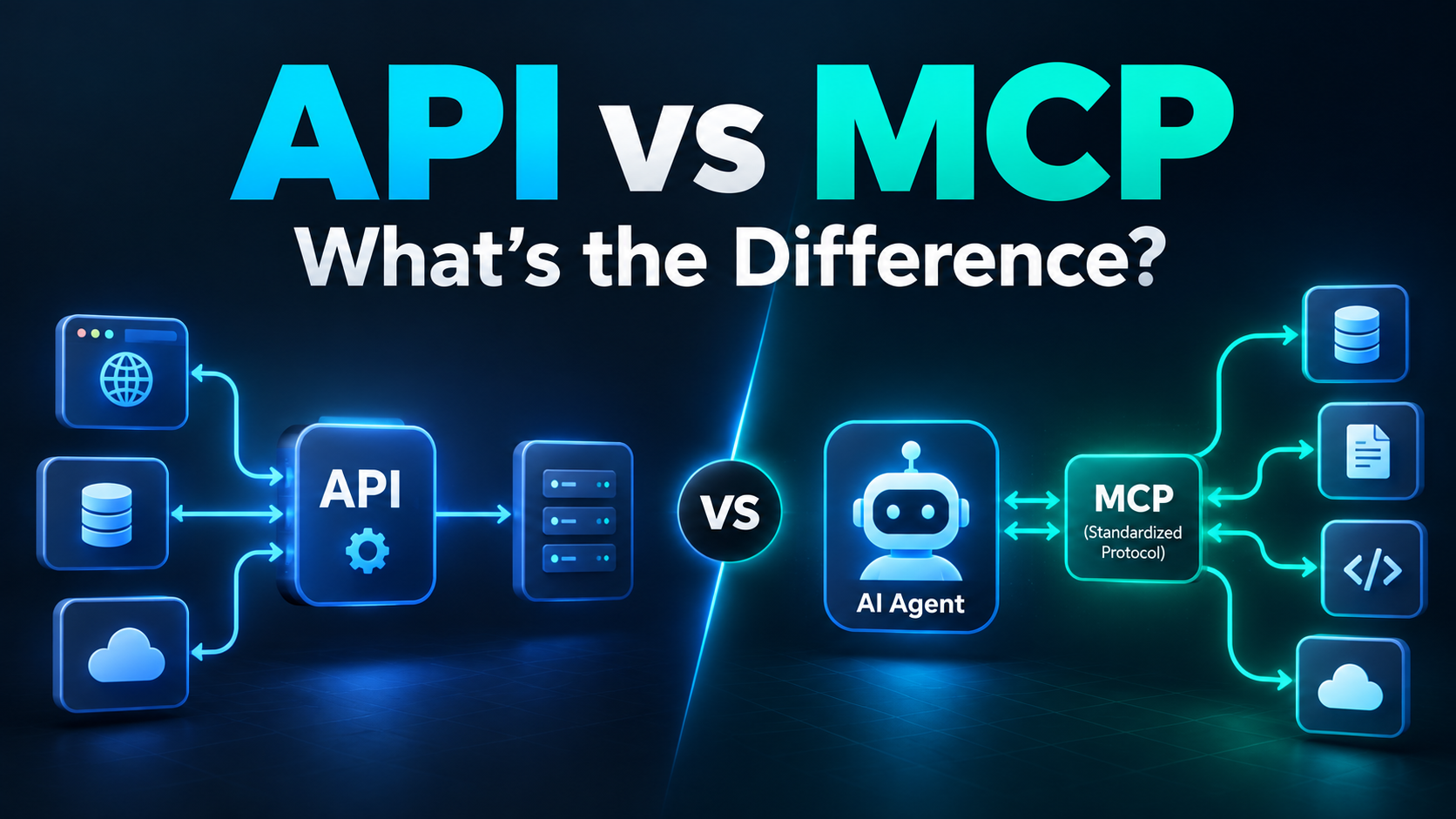
From traditional application integration to AI-driven interactions: understanding why MCP is gaining attention while APIs remain essential.
The technology industry has witnessed several major shifts over the past two decades, from the internet boom and cloud computing to mobile applications and microservices.
Today, we are witnessing another significant shift: the adoption of Artificial Intelligence.
Since ChatGPT became publicly available in November 2022, generative AI has moved rapidly into everyday business and personal workflows. From drafting emails and generating code to research and content creation, AI has changed how we interact with technology. But generating responses is only the beginning. We are now moving towards AI agents that can interact with applications, execute tasks and automate workflows.
This brings us to an important question: If APIs have been connecting applications for years, why do we need MCP?
From AI conversations to AI actions
Imagine asking an AI assistant:
"Find me the cheapest flight from Mumbai to Delhi tomorrow after 2 PM and book it."
A conventional generative AI model can explain flight options if it has access to relevant information. However, completing this request involves much more:
- Searching flight availability across providers.
- Comparing fares and schedules.
- Selecting a suitable flight.
- Initiating a booking.
- Obtaining authorization and processing payment securely.
- Retrieving the booking confirmation.
This is where an AI agent comes into the picture. It can interpret the request, select appropriate tools, coordinate multiple steps and interact with external systems.
But how does the agent communicate with those systems?
Traditionally, we rely on APIs. MCP introduces a standardized way for AI applications to discover and interact with tools and contextual information.
API vs MCP: Understanding the difference
An API (Application Programming Interface) enables software applications to communicate, exchange data and invoke operations through defined interfaces.
APIs are the foundation of modern application architecture. Whether it is a payment gateway, a CRM platform, a microservice or a mobile application, APIs make integration possible.
MCP (Model Context Protocol) is an open protocol introduced by Anthropic in November 2024. It standardizes how AI applications connect to external tools and sources of context.
Think of MCP as a common communication standard for AI applications. Instead of building a completely different integration mechanism for every AI tool, developers can expose capabilities through MCP servers that compatible AI applications can interact with.
Here is how the two differ:
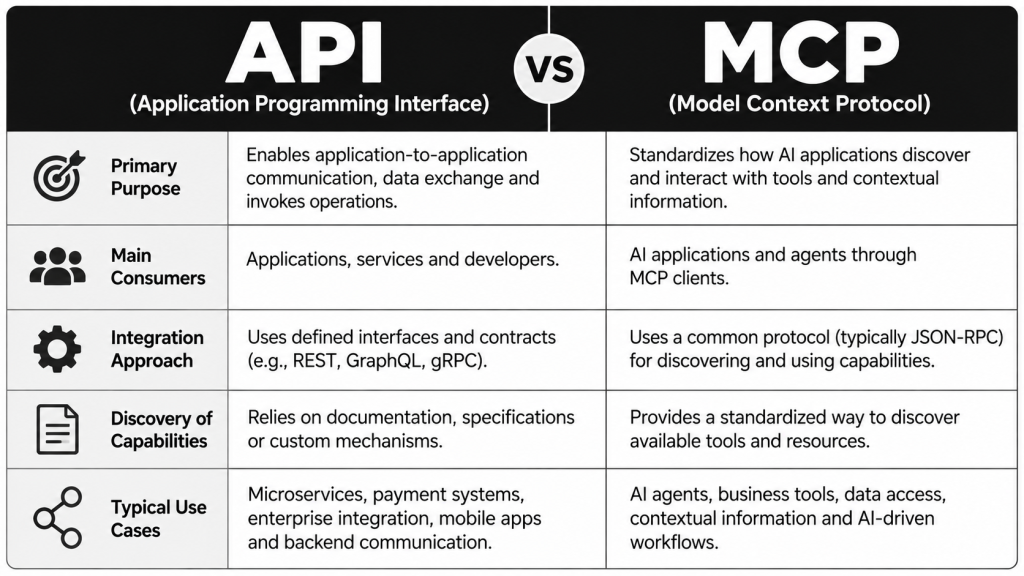
The key distinction is simple: APIs define interfaces for software interaction, while MCP standardizes how AI applications interact with capabilities exposed by external systems
How MCP and APIs work together
Let's revisit our flight-booking example.
Imagine an AI assistant connected to a flight-booking MCP server.
The MCP server exposes tools such as flight search, fare comparison and booking. The AI application can discover these capabilities and invoke the appropriate tools based on the user's request.
Behind the scenes, the MCP server may use existing airline or travel aggregator APIs to retrieve flight schedules, compare prices and initiate bookings.
Once the user confirms the selected flight, the agent can initiate the booking workflow. Payment and other sensitive actions require appropriate authorization and security controls.
The architecture might look like this:
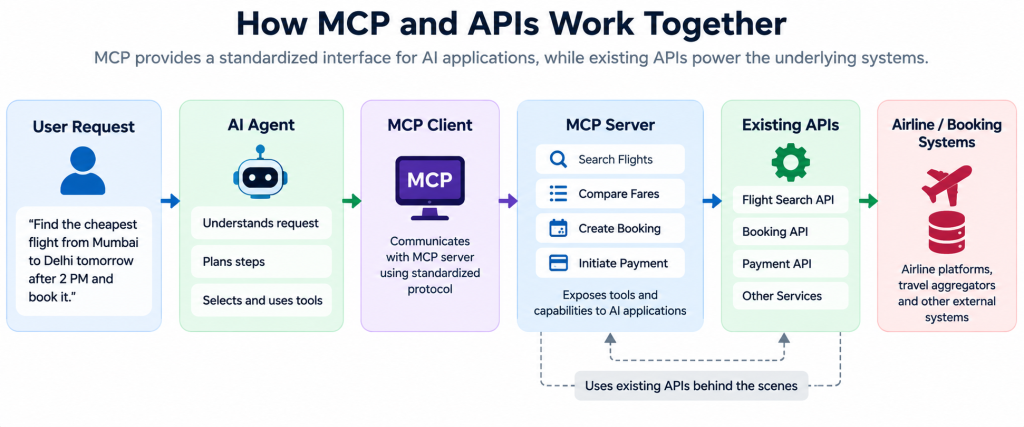
This architecture allows organizations to retain their existing API infrastructure while providing a consistent interface for AI applications.
Importantly, MCP does not replace the underlying APIs, business logic or security mechanisms.
Why MCP matters for enterprises
Consider an enterprise AI assistant that needs to access CRM, HR, ticketing and internal documentation systems.
Traditionally, developers build integrations specific to each application and AI workflow. MCP offers a common way to expose selected capabilities through MCP servers, making them accessible to compatible AI applications.
This can help organizations achieve:
- Standardized integration: Reduce custom AI-facing integration mechanisms.
- Reusability: Expose capabilities to multiple compatible AI applications.
- Faster development: Simplify how AI applications discover and use external tools.
- Better separation of concerns: Keep AI orchestration separate from existing business services.
However, MCP is not a shortcut around security, authentication, monitoring or governance. Those remain essential, particularly when AI agents can trigger business transactions.
Are APIs becoming obsolete?
Not at all.
APIs remain essential for application communication, data exchange, microservices and business transactions. MCP builds on this existing ecosystem by providing a standardized interface for AI applications.
For simple workflows, direct API integration may still be the most straightforward solution. For more dynamic AI applications that need to discover and use multiple tools, MCP can offer additional flexibility.
The choice depends on the use case, complexity, security requirements and long-term architecture.
Final thoughts
The evolution of software integration is not about replacing existing technologies but extending their capabilities to meet new requirements.
APIs have been the backbone of modern application architecture. MCP addresses a different challenge: enabling AI applications to discover and interact with external tools and contextual information through a common protocol.
APIs connect applications. MCP helps AI applications use their capabilities.
As enterprises move towards AI-driven workflows, understanding how these technologies complement each other will become increasingly important for developers, architects and technology leaders.